
Call Today on 08082508820 * or Book a Survey Online
The Differences between Wet Rot and Dry Rot?
Both wet rot and dry rot are types of fungal decay, and over time they can lead to serious damage of wood left untreated. Dry rot is often seen as the more serious form of fungal decay, but despite this, both have been known to cause severe structural damage once they take hold.
Many homeowners and landlords, especially in older properties, often come across what looks like decaying timber, and will wonder what to do next. If this is the case, and you’re worried about a fungal decay problem inside your property, understanding the differences between wet rot and dry rot is key to identifying the problem.
Fungal decay can be a complex problem that often remains hidden in hard to reach places until it is too late, so professional help is recommended in order to protect your home and ensure effective long term treatments.
How are Dry Rot and Wet Rot Different?
Wet rot is caused by hundreds of different species of fungi, many of which you will see growing in woodland. They can be categorised as either brown rots or white rots. Wet rot will often stay confined to the source of moist timber, meaning it does not spread much further.
Unlike wet rot, dry rot is caused by one specific species of fungi, known as Serpula lacrymans. Dry rot is capable of spreading aggressively across timber, through masonry, behind plasterwork and across steel beams and plastic pipes in search of new timber to consume. Dry rot will also destroy stored goods and furnishings if made of natural materials such as cardboard or wool.
Another difference in whether a fungal decay problem is wet rot or dry rot is the moisture content in which germination and growth can occur. Typically wet rot will require a higher moisture content of around 50–60% in timber, while dry rot grows best at a moisture content of 30-40%. Timber is at risk from all forms of fungal growth above 18%, even if it cannot grow rapidly at this moisture content.
Both wet rot and dry rot will thrive in damp environments and often display similar signs, and in many cases will go unnoticed in hard to reach areas such as sub floor voids and roof spaces until severe damage has occurred.
Dry rot and wet rot require different treatment methods, as the extent of the problem in a property can vary depending on the type of rot found. Because of this, accurate identification is essential, as if misdiagnosed, the problem could return.
The differences in the potential damage caused makes it important to accurately determine the type of rot affecting your property, and this is why it's important to seek professional help. Not only will this provide an explanation on the type of fungi affecting your property, but the surveyor will also be able to investigate the full extent of the problem, while offering you advice on your next steps and treatment options.
Which will cause more damage, Wet Rot or Dry Rot?
If left untreated, dry rot will typically cause more damage in a property as it has the ability to spread across surfaces and through walls, but both types can lead to severe structural damage of timber if left unaddressed.
Dry rot mycelium and strands will grow and spread from the source of moisture through masonry, behind plasterwork and across surfaces, meaning that while the moisture source is in one location in a property, the dry rot could be found across the whole ground floor and even on several stories.
Wet rot will remain isolated at the source of moisture hence it may only decay the ends of timbers embedded in damp masonry, but if the moisture source is extensive, the wet rot can lead to significant damage to timber. This may occur where decay affects the ends of all floor joists and the whole floor drops.
Regardless of the type of wood rot you face, it is advisable to seek professional advice through a damp and timber survey, in order to identify the source of moisture fueling the problem and to understand the extent of the damage to structural timbers.

Dry rot strands can grow through various materials and if left untreated, will spread throughout a property, with sporophores popping up wherever light activates their formation.
Identifying Features of Wet Rot
- Damp and Musty Smell: The smell of wet rot is typically described as damp and mouldy. This is because it is often associated with long-term leaks or consistent moisture, such as from a leaking pipe or roof.
- Spongy Timber: The wood will feel soft, spongy, or may even crumble to the touch.
- Discoloured Wood: The timber may appear darkened, which is a sign of brown wet rot, or bleached and fibrous with white wet rot.
- Fungal Growth: While not always obvious in mass like dry rot, you may see a fungal growth that looks thread-like on the surface of the timber.
- Isolated at Source: Wet rot is contained to timbers with high moisture levels, though some species will grow on masonry surfaces. This makes it easier to manage once the source of the dampness is eliminated.

Identifying Features of Dry Rot
-
Mushroom-like Smells: Dry rot is often described as having a musty, mushroom-like odour. The smell can be particularly noticeable in poorly ventilated or enclosed spaces, such as basements, sub-floor spaces, or behind furniture.
-
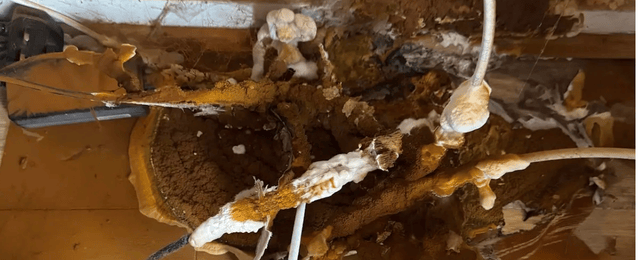
Mycelium Growth: You may see a grey, cobweb-like fungal growth with lilac tinges, or a white, “cotton wool” like growth with yellow tinges where there is poor ventilation.
-
Fruiting Body (Sporophore): A mushroom-like pancake shaped fruiting body that is orange-brown with white edges. Sporophores can grow quite rapidly and suddenly appear on skirting boards or behind furniture.
-
Spore Dust: Once mature, the sporophore will shed a fine layer of orange-brown spore dust. This red/orange dust is a clear indicator of a major dry rot outbreak.
-
Cuboidal Cracking: When broken down by the enzyme cellulase, the affected timber will split into brown cube-shaped pieces.
-
Severity: Remember, dry rot is known as the “silent destroyer” for a reason. It can travel through brickwork and behind plaster, searching for new timber to attack.
Common Locations to Find Wet Rot
Wet rot is more common than dry rot, and is found in areas with a persistent moisture source, often caused by building defects, damp and condensation problems.
-
Sub floor voids: wet rot can often be found in sub floor voids where joists are in contact with damp masonry, especially if there is a lack of ventilation.
-
Roof and attics: When tiles or roof coverings are defective, moisture can penetrate into the loft and wet rot can occur.
-
Bathroom and kitchens: High humidity areas of the property can lead to moisture running down cold surfaces and onto skirting boards, which over time can decay. Faulty appliances and damaged pipework can cause leaks that provide a source of moisture for wet rot to occur.
-
Around windows and doors: Often external wood frames and windowsills are susceptible to wet rot as they are exposed to rainwater. Internally condensation can cause wet rot on windowsills.
-
Cellars and basements: Wet rot can often occur in spaces that are below ground level, as moisture can penetrate through into the fabric of the building, providing a source of moisture for wet rot.
Common Locations to Find Dry Rot
Dry rot will thrive in areas that have poor ventilation and a source of gentle moisture. Areas of the UK where sandstone buildings are present generally have large outbreaks of dry rot and sandstone acts like a sponge and releases moisture slowly. Older buildings are susceptible to dry rot as they are more likely to have building defects that provide the source of gentle moisture.
- Sub Floor Voids: Sub floor voids are the most common place dry rot is found, especially in properties with no sub floor ventilation as airbricks have been blocked or covered over. The dry rot will spread throughout the void, causing significant structural damage.
- Behind Plaster and Panelling: Dry rot strands can often spread throughout the property behind panelling and plaster, in an attempt to find new timber to attack. This is particularly true of buildings with lath and plaster walls or wooden plugs in the mortar for fixings. Exposure may be required to understand the full extent of the damage.
- Staircases: Often dry rot is found under staircases as the underside provides a dark space with a lack of ventilation, all that is required is a source of moisture to allow for spores to germinate and this often comes from the cold outside wall the stairs is fixed to.
- Areas with a Lack of Ventilation: Dry rot thrives in dark and damp areas, with a lack of ventilation
Differences in How you Treat Wet Rot and Dry Rot
While treating both wet rot and dry rot requires removing the source of moisture causing the problem, dry rot can require more extensive repairs if the outbreak in the property is extensive. Because dry rot strands can lay dormant, it is important to remove them in order to prevent further problems in the future.
The first step is to remove the source of moisture, meaning that building defects are repaired, or elements of damp proofing are carried out. If this is not done, treatments may not be successful in the long term.
For dry rot all affected timber must be cut back and removed, before the affected area is treated with a fungicidal treatment. Where dry rot strands have been in contact with masonry, this may also need to be treated with fungicide. Plasterwork will need to be removed and all dead mycelium, hyphae or fungal fruiting bodies removed.
Improvements to ventilation may also be required to improve the airflow.
Wet rot treatments require the damaged timber to be cut back or removed entirely, before new sections are installed.
For large structural timbers such as beams, or for historic buildings where the original timber has been partially damaged, timber resin repairs can be carried out.
Expert Timber Surveys
If you are noticing signs of a fungal decay problem in your property, and would like professional advice, a damp and timber survey will help provide answers. They will investigate the decay outbreak, the source of moisture causing the problem, and then assess the extent of damaged timber. All findings will be detailed in a survey report.
Peter Cox has a number of experienced surveyors who are experts in investigating what can often be a complex problem, giving you peace of mind that comes with a professional opinion.
Our team has vast experience in carrying out damp and timber surveys on all types of buildings, so no matter the size or complexity of the problem, whether it is a domestic or commercial property, we are here to help.
Why Trust Peter Cox?
- Decades of property preservation expertise in both wet rot and dry rot treatment and remediation.
- Nationwide network of local branches, meaning a local qualified surveyor and technicians in your area.
- Our trained technicians are equipped with the right equipment and materials to get it right the first time, ensuring your property is restored and the fungal decay is dealt with.
- They are equipped with protective floor coverings, Hilti dust extraction units and vacuums in order to keep your property clean and tidy. Where possible they will cover surfaces with dust sheets in order to keep disruption to a minimum.
- We are a Which? Trusted Trader member
- Rated ‘Excellent’ on Trustpilot with more than 2,500 independent reviews.
- Typically our fungal decay treatments come with a 20 year guarantee, if applicable this will be detailed in the report. This provides long term peace of mind after the dry rot removal.
Next Steps


*Survey enquiries for your local branch will be directed to our dedicated central survey control teams across the UK. Calls to 0800 and 0808 numbers are free unless you are calling from a business phone, in which case the rate will be set by your provider.