
Call Peter Cox on 08082508820 * or Contact Us Online
Tynemouth damp proofing and rot treatment
The qualified and experienced surveyors and technicians at Peter Cox in Tynemouth can offer the right treatment plan, the highest standard of work and a long term guarantee for all of our damp and rot treatments. Whether you need our expertise in you home or business property our team are ready for your call today.
The case study on this page details a damp and rot treatment we did 19th century terrace in Tynemouth and will give you a fantastic insight into the sort of work we can do. Alternatively, if you want one of our experts to survey your property in Tynemouth today then click the button below to book a survey online.
Damp on the homebuyers report
Built in 1898, the terrace property located in Tynemouth had no previous issues with rising damp, indicating the original damp proof course had been doing its job for well over 100 years. Peter Cox were called in by the prospective purchaser of this property to case their expert eye over the house inside and out.
After a thorough homebuyers report, a small patch of rising damp was highlighted indicating the original damp proof course had failed at the front of the property. This visible patch had been caused by soluble salts deposited in the wall fabric and plaster as moisture from the rising damp evaporated. From an external observation there appeared to be insufficient air ventilators to provide adequate sub floor ventilation.

Evidence of the typical ‘tide mark’ of rising damp, with the solid brick wall noticeably damp, while interior paint had started to peel and crack.
Defects noted in the survey report
Alongside the rising damp issue, the report also highlighted weak timbers in sections of the property, around both the fireplaces in the living room and dining room, and a stretch of hallway flooring leading to the kitchen.
As the carpet had been removed further investigation took place showing the extent of the problem. The floorboards were removed to reveal the void filled with rubble, blocking ventilation, giving the perfect conditions for a wet rot outbreak.
Wet rot explained
Wet rot is a form of fungal decay that attacks timber and requires a constant source of moisture to grow. While not as severe as dry rot, wet rot can still thrive in the right conditions and ultimately can lead to structural integrity problems if not dealt with.

Moisture was able to rise through the rubble leading to a wet rot outbreak.
Applying rising damp treatment
The first step was to remove the existing plaster as it had been contaminated by hygroscopic salts, removed to 300mm higher than the highest salt stains, or to a minimum height of 1 metre.
Once the plaster was removed horizontal holes were drilled around 12 mm apart into the wall mortar joint, both internally and externally and a silicone based liquid was then injected into the holes.
This damp proof injection works as the silane vapour reacts with the silica in the masonry forming a water repellent barrier. This means the cream can be injected at intervals to leave a completely damp proofed solid wall, rather than installing a solid course right across the building.

Replastering
After the damp proof injection the wall was replastered. To control the dampness already in the wall the internal plaster needs to be capable of preventing hygroscopic salts affecting the wall surface (therefore preventing the paint from peeling and cracking again).
The plastering was a typical sand and cement render mix followed by top coat, which can take up to 6 weeks to fully dry, when it can then be repainted or decorated. The external holes were then mortared back up, leaving the damp proof course invisible to the eye.

How we repaired timber affected by wet rot
The rubble blocking the sub floor void which had caused the wet rot problem was bagged up and removed from the property, and sections of rotten joists and floorboards were cut out back to sound timber. News timber joists and sections were then installed in the three areas of the property affected by wet rot. Any exposed timber in the area was also coated with a fungicidal treatment to protect from another outbreak of wet rot, then new floorboards were installed, ready for a new carpet to laid.
The old air bricks were removed, the airway cleared and new larger air bricks installed allowing for more ventilation in the sub floor void under the property. This airflow will help prevent another outbreak of fungal decay with improved ventilation. Peter Cox Wet rot treatments come with a 20 year guarantee.
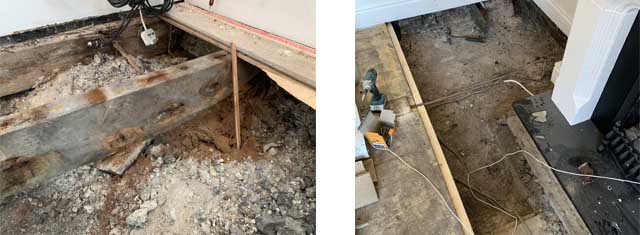
Wet rot had caused severe structural damage to the joists, so rubble was removed, ready for new joists to be installed.
Providing peace of mind for our customers
Damp proof course installations can potentially be messy work, with drilling into masonry and hacking off plaster work involved. Peter Cox will always cover up flooring and try and keep disruption to a minimum, however some dust in areas is unavoidable. Peter Cox technicians are all equipped with rubble bags to remove waste, and hoovers to clean up and leave your home as tidy as possible afterwards.
All damp and wet rot work carried out by Peter cox comes with a 20 year guarantee. Peter Cox have issued over 500,000 long term guarantees since we were founded in 1951, and it can be transferred to new property owners should you move house.
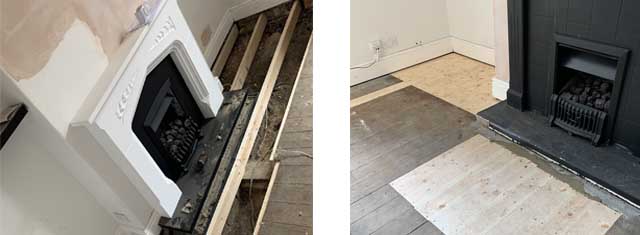
New joists were installed, the sub floor void was cleared out and new floorboards fitted.
Contact our rising damp and wet rot specialists
If you think you need our expertise then please get in touch. Complete the contact form below.
Next Steps
Specialist Services
Find out more about the specialist services we provide:
*Survey enquiries for your local branch will be directed to our dedicated central survey control teams across the UK. Calls to 0800 and 0808 numbers are free unless you are calling from a business phone, in which case the rate will be set by your provider.