Book A Survey
Book Online Now!

Call Peter Cox on 08082508820 * or Contact Us Online
Edinburgh's iconic Nelson Monument, a towering tribute to Vice Admiral Horatio Nelson’s victory at the Battle of Trafalgar, recently underwent vital restoration. As part of this restoration work Peter Cox were employed by Ashwood Scotland to address the damaging effects of wet rot. This case study explores how specialists from Peter Cox surveyed and treated the historic structure, helping ensure its preservation for generations to come.
Perched atop Calton Hill, the 32-meter-high Nelson Monument has stood as a lasting fixture since construction began in 1807. One of its most distinctive features is the "time ball," which is raised and lowered to mark the time, a nod to the monument’s maritime heritage. However, the very elements it has withstood for over two centuries, particularly Edinburgh’s damp climate, have begun to take their toll.
Peter Cox was brought in by main contractor Ashwood Scotland to conduct a comprehensive damp and timber survey of the monument’s upper roof that sits below the mast and time ball. Due to the monument’s exposed location and predominantly timber internal construction, it was particularly vulnerable to rainwater seeping in - a common issue in historic stone buildings.
The survey, carried out by a qualified Peter Cox surveyor, revealed a problem with two vital structural roof support beams that had been severely compromised by wet rot. In addition wet rot was also found in other small sections including the collar supporting the timeball.
Wet rot is a form of timber decay caused by fungal growth in wood that stays damp over time. Though less aggressive than its counterpart, dry rot, wet rot can still cause significant damage if left untreated - weakening structural timber and compromising stability. In historic buildings, defective roofing, damaged gutters, or blocked drains often allow moisture to seep in, creating ideal conditions for wet rot to thrive.
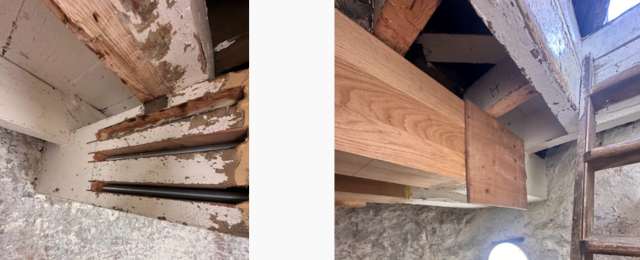
Due to the nature of the damage, Peter Cox recommended repairing the beams using a special strong glue and timber patch called a timber resin splice (TRS). This technique is especially suitable for historic buildings, as it enables targeted repairs that preserve as much of the original structure as possible, minimising the need for full beam replacement. The treated area can also be expertly blended to match existing timber, ensuring a seamless aesthetic.
The treatment process involved an intricate sequence of steps:
Above: Anchored rods extend from the new beam into the existing structure. A shutter is constructed around the joint, and liquid epoxy resin is injected to fully encase the stainless steel rods.
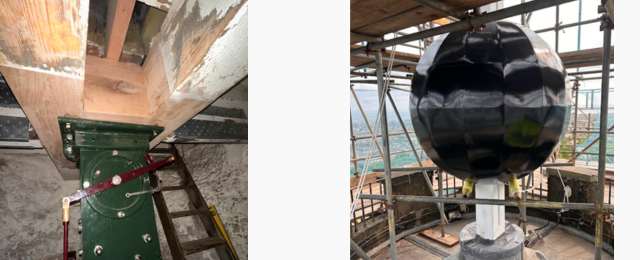
In addition to the beams, decayed sections of the dome timber collar surrounding the flagpole were removed and replaced with new timber and resin-bonded in place to restore the flagpole’s collar.
Surveyor Rhys Winter reflected on the project: "It was quite an experience carrying out a survey so high up on a historic monument. With the damage to the structural beams, we knew they had to be cut back and sections replaced. Thankfully, with the timber resin splice method, we only had to remove the minimum amount of timber needed to minimise disruption. It was an honour to be part of the regeneration of this monument."
With the wet rot removed the original mechanism built by Maudslay Sons & Field Engineers in 1853, responsible for raising and lowering the time ball, could be safely reinstalled in its newly restored housing.
The successful restoration of the Nelson Monument stands as a testament to the expertise of all members of the project including Peter Cox.
It highlights the importance of timely and specialised intervention in preserving our architectural heritage, ensuring that iconic landmarks, like the Nelson Monument, continue to inspire and endure for centuries to come.
*Survey enquiries for your local branch will be directed to our dedicated central survey control teams across the UK. Calls to 0800 and 0808 numbers are free unless you are calling from a business phone, in which case the rate will be set by your provider.