“This property had a significant dry rot problem, which is one of the most destructive forms of decay found in buildings across Scockport. The primary cause was moisture building up due to reduced sub-floor ventilation. By clearing the obstructions, installing new vents, and sterilising the masonry, we’ve ensured the problem was dealt with thoroughly."
— Andrew Singleton CSRT CSSW, Senior Surveyor

Call Today on 08082508820 * or Book a Survey Online
Dry Rot Repairs in a Domestic Property in Stockport
Stockport, Greater Manchester, has a diverse range of housing, including terrace housing, industrial properties and traditional cavity brick-built semi-detached homes.
While many of these properties have survived for years, over time, buildings are susceptible to building defects, which can lead to property preservation problems.
Peter Cox was called in to carry out a damp and timber survey in a property in Stockport after the homeowner had noticed the deterioration of internal timber.
A specialist damp and timber survey was carried out by our local surveyor to determine the cause and extent of the issue.
Damp and Timber Survey in Stockport
The surveyor began with an external inspection of the property, noticing problems with high ground levels and noticed airbricks had become obstructed with debris.
Airbricks provide ventilation and air circulation in the subfloor void, preventing moisture buildup in structural timbers below the property.
Internally, the surveyor noticed that the timber floor had become structurally weakened, and once the subfloor void was exposed, a subfloor inspection revealed decay caused by the dry rot (Serpula lacrymans) fungus.
The extent of the dry rot outbreak included damage to joists and floorboards, with hyphae growing through surrounding masonry. Thankfully for the homeowner, the dry rot was limited to the subfloor void under the hallway of the property and had not spread further.
Dry rot is capable of spreading through masonry, behind panelling and across plasterwork in search of new timber to attack.
The surveyor provided a detailed survey report, outlining their recommendations for treatment to prevent the problem. This included dry rot control measures, the removal of affected plasterwork, masonry sterilisation and then improvements to ventilation in the subfloor void.
Dry Rot Treatment Stockport
The homeowner went ahead with the works, and Peter Cox technicians were then on hand to carry out timber repairs.
Wall plaster was hacked off in affected areas to expose the underlying masonry for treatment. This is necessary as dry rot strands must be destroyed to prevent a further outbreak.
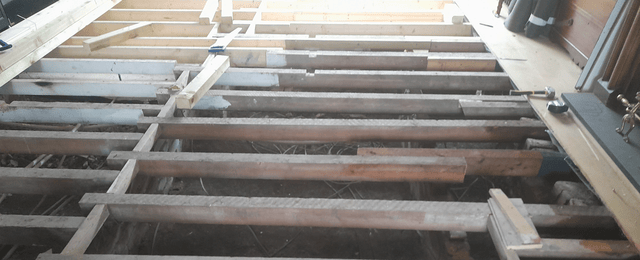
Decayed floorboards and joists were then removed before surrounding brickwork was wire-brushed and treated with a fungicidal fluid. To prevent the fungus from spreading through the masonry, holes are drilled staggered at different heights, in a technique known as a toxic box.
New joists and floorboards were then installed. All joist and beam ends were wrapped, protecting them.
Existing vents were cleared, and additional air vents were installed to ensure a permanent flow of dry air.
The homeowner was also advised to reduce an external step that was hindering airflow.
Throughout the process, our technicians were on hand to explain the process from start to finish, while minimising disruption for the homeowner. They were equipped with protective floor coverings, Hilti dust extraction units and vacuums in order to keep the property clean and tidy.
The property was restored to its former condition, with all structural timber replaced, leaving the homeowner with peace of mind that the problem was solved long-term. They had the added comfort of a long-term 20-year guarantee, typical for our fungal decay treatments.
The local surveyor said:
Conclusion
This case in Stockport highlights how critical adequate ventilation is to the health of a building. Through a combination of thorough surveying, targeted fungicidal treatments, and improved airflow, the property is now fully protected against the return of dry rot.
If you are worried about musty smells, crumbling joinery, or signs of fungal growth in your home, book a damp and timber survey with Peter Cox today to safeguard your property.
Next Steps
*Survey enquiries for your local branch will be directed to our dedicated central survey control teams across the UK. Calls to 0800 and 0808 numbers are free unless you are calling from a business phone, in which case the rate will be set by your provider.