Timber Surveys
Find out more about our Timber Surveys

Call Peter Cox on 08082508820 * or Contact Us Online
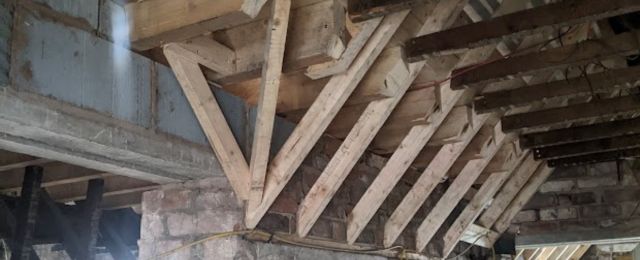
Peter Cox were called in to a property in Ashton-in-Makerfield, on the outskirts of Wigan, where a severe outbreak of dry rot had taken hold across multiple floors of the property in the highstreet.
With the building remaining fully operational during the remedial works, Peter Cox were able to carry out a specialist remediation programme to address the extensive fungal decay while keeping disruption to a minimum so business could carry on as usual.
The client had requested a detailed damp and timber survey following concerns about timber decay in the property. They had noticed the tell tale signs of fungal decay, but were unsure on what to do next.
On attending the site, our surveyor quickly identified the hallmarks of a serious dry rot outbreak (Serpula lacrymans), with evidence of sporophores and spore dust throughout both the first and second floors. The ground floor, being used as a commercial premises, was unaffected.
The root cause was traced to ongoing water ingress over several years, linked to unresolved external defects including damaged and defective roof coverings and guttering as well as delaminated sandstone sills and lintels.
A number of additional site-specific challenges complicated the survey process, and recommendations for work:
To ensure safety, a full asbestos survey was completed prior to works commencing. This confirmed no asbestos in the areas we worked on, allowing Peter Cox to proceed.
In line with Peter Cox best practice, the first step was an exposure survey to uncover the full extent of the dry rot infestation before any remediation could begin.
Once the survey was completed, a full scope of work was provided to the client, along with a detailed method statement. Our repair specifications fully comply with any relevant British Standards.
The recommendations involved:
Following the exposure phase, our team developed a detailed specification for the treatment and restoration phase. This included:
Our works were coordinated alongside the main contractor’s responsibility to rectify the external maintenance defects, an essential step in ensuring the long-term success of the internal dry rot treatment.
The exposure works successfully revealed the full scale of the hidden infestation, allowing a targeted plan to be implemented by a trained and qualified CTSDB surveyor.
Despite the logistical constraints of working in a commercial premises still in use, Peter Cox delivered a well-coordinated, low-disruption solution that laid the foundation for long-term structural preservation for the client.
This project demonstrates the importance of early diagnosis and specialist intervention when tackling severe dry rot in commercial properties.
Peter Cox are well equipped to deal with commercial projects, our local teams have the necessary contract management skills in place, and an independently accredited health and safety regime that includes rigorous training for our surveyors and technicians, who carry CSCS cards.
Find out more about our specialist service we provide
*Survey enquiries for your local branch will be directed to our dedicated central survey control teams across the UK. Calls to 0800 and 0808 numbers are free unless you are calling from a business phone, in which case the rate will be set by your provider.