
Fungal Decay in Buildings
Wood is a very resilient material which is able to remain intact for hundreds, if not thousands of years, but introduces moisture and things can change quite rapidly. Both wood boring insects and fungi prefer wood to be moist, for decay to occur.
In the case of insects, it is because it is their only moisture source and in the case of fungi, wood above 20% moisture content allows spores to germinate and fungal mycelium to grow.
Wood reaches ‘fibre saturation point’ around 25-30% depending on species and most of the fungi we deal with reach optimum growth at 30-50%. Timber in an average house is usually around 10-15%. Because of this, when timber becomes saturated with moisture, it can lead to fungal decay in buildings.
The species of wood can also plays a major role in fungal decay. Cedar wood contains naturally occurring fungicides, whilst teak is almost immune to decay, but at the other end of the scale, Sycamore is considered to be perishable.
Wood also contains two main areas of growth, the heartwood in the centre of the tree, which is usually durable and the sapwood around the outside of the tree, which was the living part and is always considered perishable if it becomes damp.
In reality, when trees are felled and converted into timber, each length will contain heartwood, sapwood or a mixture of both and if kept dry throughout its life, most species used in construction will prove perfectly serviceable.
When timber is used in the construction of a building, we try to ensure that it is kept dry at all times. Provided no roof tiles break, lead flashings stay in place and the felt stops water penetration, all will be well in the roof.
Further down, timbers need to be isolated from the masonry so they remain unaffected by penetrating damp or rising damp.
For the whole structure it is important that the right levels of ventilation are maintained to all parts so the timber moisture content does not rise above 20%, when they can be put at risk of fungal decay.
What are Timber Decaying Fungi?
Fungi are neither plants nor animals – they fall between. Just like humans, they use enzymes to break down their food source, but contain no green chlorophyll, so do not photosynthesise.
They are found throughout the world and it has been estimated there are at least 3 million species, of which a proportion break down wood fibre and are a very important part of the ‘carbon cycle’.
Fungi start life as a spore (a seed in a plant), floating through the air. The spore lands on a suitable food source at the correct moisture level and temperature, in this case wood.
The spore germinates and puts our hyphae (‘roots’), just like you see with bread mould.
The hyphae advance over the surface of the food source and excrete enzymes which break down the food source and the food is then absorbed. As the hyphae age and merge together, they become a mycelial mass.
In the case of dry rot, this mycelium can penetrate brick, concrete and mortar as it searches for more wood to digest.
For other fungi, they either only remain on wood or they may be able to grow over the surface of masonry. With most fungi, light prompts a chemical reaction that causes the fungus to bloom and form a sporophore (flower). For most of the fungi in buildings, this does not look like woodland mushrooms, but meets the same purpose, which is to shed spores and the life cycle goes full circle.
Why does Fungal Decay Grow in Buildings?
Fungal decay can only occur in buildings if all the correct conditions for growth are met.
Although there are common requirements, just like humans, different fungi have adapted to live in different environments around the world and some environments where fungi thrive, may kill others.
For example, the feared Dry rot (Serpula lacrymans), can grow as low at 5ºC, is best at 22ºC and will stop growing around 26ºC. It is killed by exposure to 40ºCc for 15 minutes.
The main requirement for fungi to grow are:
| A source of food | In this case wood. The wood must be at the correct moisture content for that species. If a spore lands on a dry piece of wood, nothing will happen. | |
| The moisture source | This could be rain from a leak, penetrating damp through porous masonry onto built in timbers, rising damp, flooding or even condensation, caused by lack of ventilation. | |
| The correct temperature | The required temperature will differ depending on the species of fungi. Below freezing and your water source is blocked, so few species grow well at low temperatures. Mine fungus (Fibroporia vaillantii) grows best at 27ºC, but will go as high as 36ºC. | |
| Darkness and undisturbed conditions | Most fungi do not like growing in the sun as it dries both their food source and their tissue. Typically fungi grow best in voids where there is very little or no ventilation, meaning that when temperature and humidity are very stable and growth is optimum. This can occur when the air bricks to damp sub-floor voids become blocked. |
Types of Fungal Decay that affect Buildings
It is very important to correctly identify the type of fungal decay you have and the species involved, as this can affect the way in which you approach the infection and treat it. It is not impossible to have more than one species present in an area if the various environmental requirements can be met.
Dry rot can spread away from the moisture source, across plaster and find the next piece of wood to digest.
Wet rot damage is limited to the timber although the original water ingress may cause other areas to be affected by damp, such as plaster and decorations. It is also frequently associated with woodworm, especially woodboring weevil.
Most species can be identified with reasonable certainty provided temperature, moisture content and wood species are recorded. But you should be aware that fungal decay does not always look like the pictures in a book, particularly if the fungus is stressed.
Fungi are classified by the way they change the colour of the wood they decay. The main groups are brown rot and White rot. Just to confuse matters, wet rot can be a brown rot or a white rot. But Dry rot can only ever be a brown rot.
Brown Rots
These include Dry Rot (Serpula lacrymans), Mine Fungus (Fibroporia vaillantii) and Cellar Fungus (Coniophora puteana), the three common fungi found in buildings. The first is obviously dry rot, but the other two are types of wet rots.
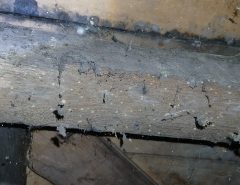
These fungi secrete the enzyme cellulase which breaks down the cellulose and hem-cellulose in the cells of the wood. The timber turns brown and cracks cuboidally.
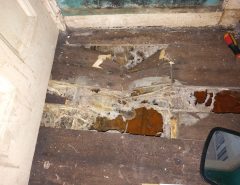
In advanced dry rot, these cracks can be very large and where skirting board or match boarding is decayed, so much structure is destroyed, the wood can curl back on itself. If the decayed timber is not brown it can’t be Dry rot.
White Rots
These include such well known species as Donkioporia expansa (Oak rot) and Phellinus contiguus.
These fungi secrete the enzymes lignase and cellulase and attack all the components of wood, cellulose, hemicellulose and lignin. The wood loses all strength, becoming bleached and fibrous. Hence the term ‘stringy white rot’. Chemical attack can be mistaken for White rot as the timber will become fibrous when subjected to acids and alkalis.
Dry Rot
As mentioned above, Dry Rot (Serpula lacrymans) is the fungus most homeowners fear and with good reason. In the right conditions, this brown rot can spread rapidly through voids within a building and through party walls from neighbouring properties.
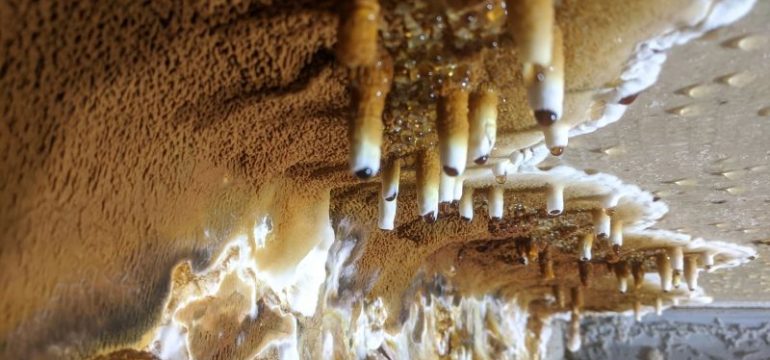
Spread is usually most rapid once sporophores are produced and spores are taken all around a building on air currents. Average rate of mycelial growth in the UK is around one metre a year, though 4 metres has been achieved in the laboratory.
But that raw fact hides the way it spreads, because growth is from every germinating spore.
If spores have been spread on air currents through the sub-floor space under a property and conditions are good, then spread of infection can be very rapid.
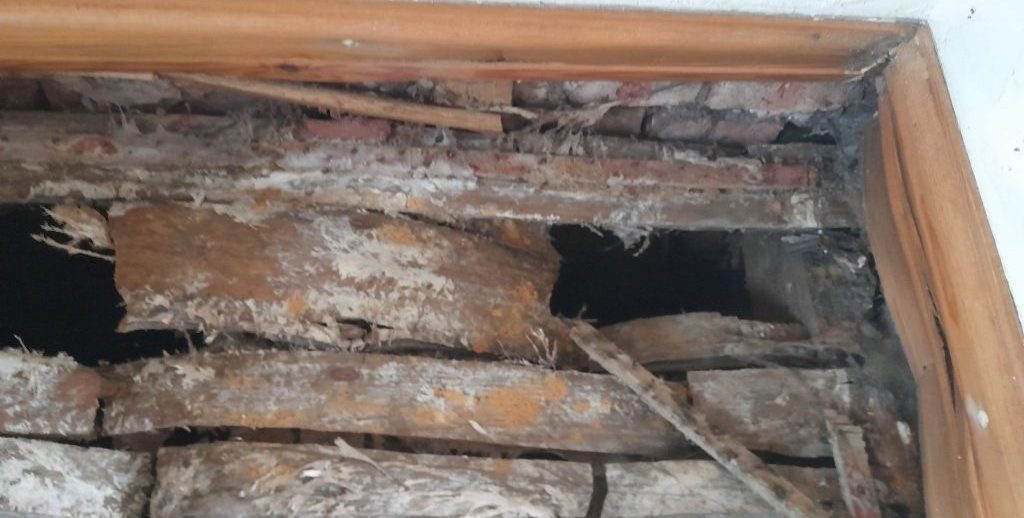
The fungus can only feed off moist wood, but wood is found in many forms in properties, there are the structural and joinery timbers, the very small fixing timbers behind plasterwork in old properties, lath and plaster, furniture and more recently wood wool insulation. They are all at risk if they become damp.
Plaster Fungus
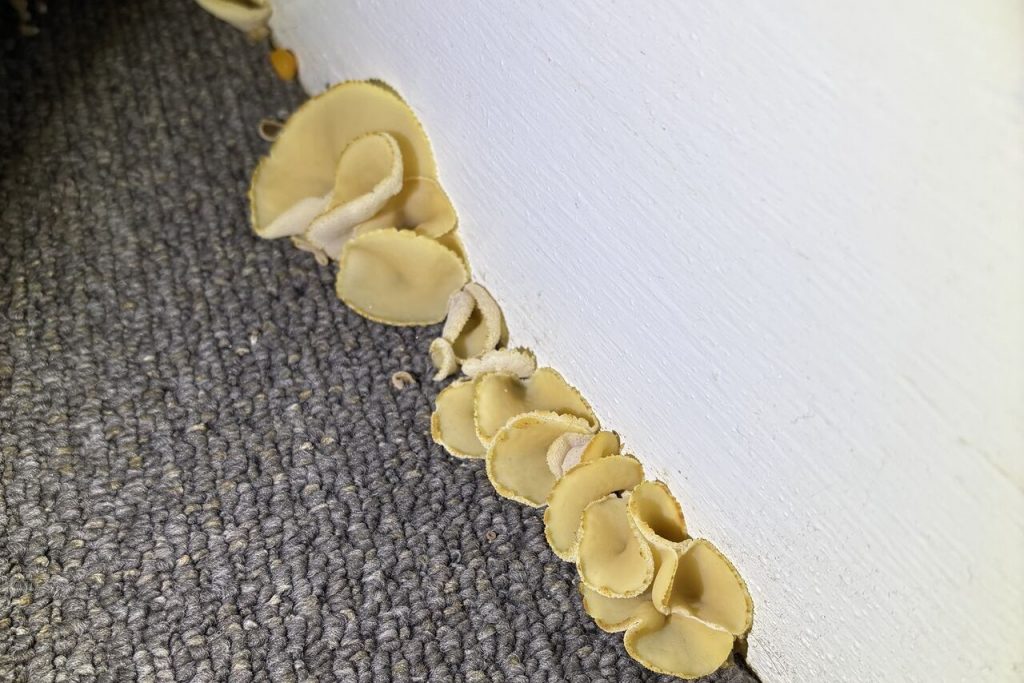
Plaster fungus of which Peziza sp is the best known species, is not a wood rot fungus, but lives off detritus on plaster and brickwork. It’s sporophores are small and fleshy, looking like elves ears, hence its common name ‘Elf cup’.
However, what it does warn you of is that the substrate is absolutely sodden, as often occurs from a major water leak or overflowing downpipe.
This can have serious consequences for built in timbers or lath and plaster walls which may then be attacked by dry or wet rot as the structure dries after the leak is addressed.
Ink Cap
Ink cap (Coprinus sp) looks like a tiny toadstool with a very thin stem. It grows in very similar conditions to plaster fungus, so its appearance on a window frame should not be ignored.
When the sporophore is mature, it drops its spores in an inky black liquid. In the right growth conditions, its mycelial mat looks like coconut matting.
Mould
Mould is just a different form of fungus, but one that is indicating lack of ventilation, cold surfaces and excess humidity within a property. This can manifest itself in a basement or subfloor, on the walls within a property or within the roof void. The cause is the same for all conditions, excess moisture production and a failure to provide adequate ventilation.
Where occupants struggle to adequately heat a property, and efforts are taken to stop heat escaping, good ventilation can be difficult to achieve, therefore humidity builds up.
World Health Organisation (WHO) Guidelines suggest indoor air quality in living areas is best around 18-20ºC, 50-60% relative humidity and with a minimum 10 litre/second ventilation rate.
1 in 5 Properties in the UK will suffer from condensation at some point and this is most pronounced from October to April when temperatures are at their coldest and windows are often closed to keep the heat in. An average household produces 14 litres (24 pints) of water vapour per day (98 litres/21 gallons a week). Once surfaces reach 70-80% relative humidity, mould spores can germinate after being wet for 6 hours. But some moulds can grow at lower RH.
Fungal Decay Solutions
Where fungal decay is concerned, the single most important step is to locate the moisture source that is ‘feeding’ the decay. Unless this is addressed, no amount of other repair strategies will get to the bottom of the issue and halt the decay permanently.
A professional CSTDB or CSRT qualified surveyor will inspect the extent of the decay and confirm whether or not the problem is wet rot or dry rot. To an untrained eye they may appear similar, but because the treatment process is different, accurate identification is key.
During a damp and timber survey they will check both the exterior and interior of the premises, to identify the source of damp causing the outbreak. A thorough inspection is required, as often fungal decay remains hidden under floorboards, behind panelling or in out of sight areas. They will then provide you with a detailed survey report outlining their findings.
With wet rot, this thorough inspection of moisture source and affected timbers will usually provide an adequate understanding of the issues, such that a comprehensive report can be prepared. But for dry rot, this may also require exposure work to the decayed area to fully understand how far the dry rot extends and enable a full specification and pricing to be completed.
Without opening up areas around infected timber or where sporophores are coming through, you may be totally unaware of the degree and extent of fungal infection.
Peter Cox has a number of experienced technicians who can carry out fungal decay repairs, and where required carry out timber resin splices. Timber resin repairs can be used to repair partially damaged timber in heritage properties. A new section of timber is bonded to the existing timber to create a seamless join.
Mould requires a different approach, to understand moisture production within the property, moisture removal and where cold condensing surfaces are present. This can be assisted by the use of a thermal imaging camera to pick up cold or damp surfaces. Once the conditions inside the property are understood, we can offer Positive Input Ventilation and extraction fans to improve indoor air quality as well as remove excess humidity.
If solid walls are found to be suffering from penetrating damp we can apply masonry protection cream on the outside. This prevents moisture ingress, but still allows moisture vapour to leave the wall. The wall dries out and the interior surface becomes warmer and is no longer a cold condensing surface.
Where the inside of the property is concerned, we offer a mould cleaning service that can be followed by the application of a thermal paint if small areas of mould are forming on cold spots or the application of thermal plaster to all cold walls.
In both cases the products raise the surface temperature of the wall above dew point and condensation can no longer form, thereby removing the conditions for mould to grow.
Specialist Diagnosis and Repairs for Fungal Decay
If you have a fungal decay problem affecting your property, you may require professional assistance. Peter Cox have been diagnosing fungal decay and carrying out specialist treatments for decades. Book a Professional Damp and Timber Survey with Peter Cox today for long term solutions for fungal decay. Typically our wet rot and dry rot treatments are backed by long term guarantees.