
For homeowners, landlords, and property renovators, particularly those responsible for older or historic buildings, discovering timber decay is a deeply concerning scenario. Wood is a foundational building material used in most British properties, providing the structural skeleton for floors, stairs, roofs, and internal walls.
When timber structures are compromised by fungal decay, the structural integrity and value of the entire building are put at risk. Among all forms of timber rot, one species stands out as the most destructive and aggressive: Dry rot (Serpula lacrymans).
Dry rot is capable of destroying wooden structures and can travel through masonry, behind plasterwork, and across metal surfaces in order to find new timber to consume. This is why it is so destructive and must be caught early to avoid costly repairs.
If you suspect your property is suffering from timber issues, learning how to identify the first signs of dry rot is the critical first step toward protecting your home.
Identify Dry Rot: Early Signs and Symptoms
Catching timber decay as early as possible can save property owners thousands of pounds and prevent severe disruption to occupants.
Recognising what dry rot looks like is essential for early diagnosis, requiring a keen eye for both direct physical changes to the wood and indirect environmental changes in the room.
Environmental Signs
Often, before the spectacular, fluffy mats or giant mushroom fruiting bodies become visible in a room, the fungus leaves subtle, early warnings on wall finishes and in the air:
- Unusual Odour: A distinct, damp, earthy, and lingering “mushroom-like” smell is often the very first clue before visible timber damage appears. This scent easily penetrates through gaps in the floor and vents into the main living areas.
- Blistering Paint and Wallpaper: Damp problems are often the cause of dry rot outbreaks, meaning that the blistering, peeling, cracking, or bubbling of paint, wallpaper and plasterwork can signal an underlying moisture problem.
- Warped Timber: Door frames, floorboards, or skirting boards that suddenly begin to warp, twist, shrink, or pull away from the plasterwork are classic signs that moisture is distorting the wood fibres.
- Spore Dust Accumulation: An active infestation producing reproductive spores will cover floors, ledges, and surfaces in a fine, rust-coloured or reddish-brown dust layer that closely resembles cinnamon or rust. The spores move around a property on air currents.
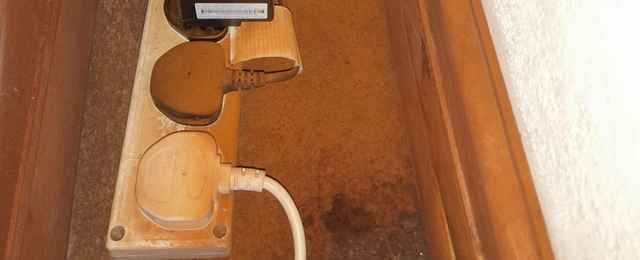
Dry rot spore dust is a clear indication of a fungal decay issue, often originating from hidden places like subfloor voids
Visual and Physical Signs of Fungal Decay
If the early signs are missed, the fungus will aggressively alter the physical makeup of the timber.
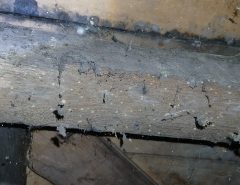
- Deep Cuboidal Cracking: As the fungus extracts moisture and nourishment from the wood cells, the timber shrinks rapidly, darkens, and develops deep cracks in a distinct cross-grain, block-like pattern. This leaves the wood fractured into fragile, square-shaped blocks. This is known as cuboidal cracking.
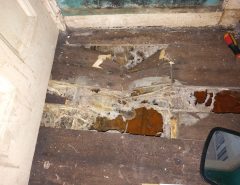
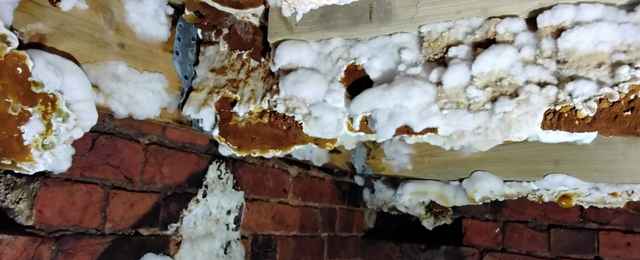
- Fungal Growths (Mycelium): You might spot fine, cobweb-like strands of fungal growth spreading across materials, or thick, white or greyish-white cotton-wool-like patches spreading in humid, unventilated spaces. These mycelium mats can develop sulphur yellow, lilac, or purple highlights.
- Fruiting Bodies (Sporophores): Look for tough, fleshy, pancake or mushroom-like structures with a wrinkled centre that exhibit a distinctive brick red, orange colouration, bounded by a clean white fleshly outer margin.
- Physical Failure of Timber: Poke suspect timber with a screwdriver or a pointed object. If the tool sinks easily into the wood with little resistance, or if the timber hollowly echoes and crumbles into a dry powder in your hands, rot has completely compromised its internal integrity. At this stage, the wood has lost all density and can no longer support structural loads, which, if left, can lead to the collapse of floors.
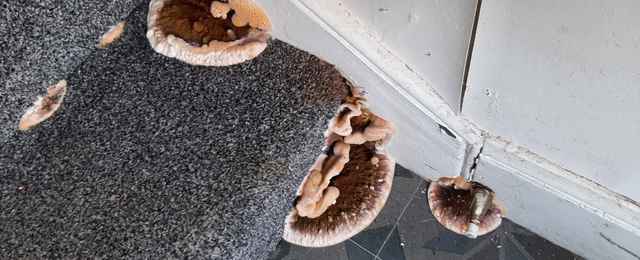
Dry rot fruiting bodies are a clear sign of a serious problem which needs to be addressed as soon as possible in order to prevent any further spreading of the infection.
Dry Rot vs. Wet Rot: Differentiating the Two Threats
One of the most common mistakes made by property owners and DIY enthusiasts is misdiagnosing dry rot as wet rot, or vice versa. While both of these structural issues are destructive forms of fungal decay that thrive on timber, they require different operational approaches.
Misdiagnosing the problem can result in spending significant money on targeted treatments that do nothing to solve the actual type of rot attacking your building.
The primary differentiator between these two wood-destroying fungi comes down to their moisture requirements and their capacity to spread through non-timber surfaces.
- Dry Rot (Serpula lacrymans) is highly aggressive and carries a severe structural danger level because it can survive, settle, and progress at significantly lower timber moisture thresholds, typically around 20% to 22%, but 30-40% is optimum. In unventilated spaces, it forms a thick, fluffy, white-and-grey cotton-wool-like mycelium mat marked by distinctive yellow or purple highlights. In ventilated spaces, this becomes a fibrous grey cream mat. This advancing front can move at around 1 metre a year, but this is heavily dependent on temperature and humidity. As it feeds, it creates deep, large cuboidal cracks across and along the grain, completely crumbling the wood and pulling moisture through root-like strands to travel across and through stone, mortar, and brickwork to target sound timbers in adjacent rooms. If left unchecked, dry rot can result in widespread structural collapse.
- Wet Rot (such as Coniophora puteana, or Cellar Fungus) requires constant, high moisture saturation levels closer to 40% to 60% to stay active and survive. Unlike dry rot, wet rot is localised and remains restricted strictly to the immediate damp area where an active plumbing leak or external defect is occurring. It cannot spread or travel through structural masonry, though some species can grow across it. Visually, most wet rot produces thin, sparse, dark brown or white thread-like strands and results in much smaller, narrower longitudinal wood cracking that heavily darkens and softens the affected timber. Some wet rots ‘bleach’ the wood and make it fibrous. Its risk level is moderate because the structural damage remains strictly confined to the leak site.
What Causes Dry Rot?
Understanding the causes of dry rot is the only way to establish long-term protection for a property. Fungal spores cannot cause an infection on their own; they require a specific combination of environmental triggers to germinate and thrive:
1. Water Ingress
Because the fungus requires moisture, the root cause is almost always a building defect or plumbing issue. Common triggers include:
- Defective roof coverings, such as slipped tiles.
- Faulty lead flashing around exposed chimney stacks.
- Overflowing, blocked, or leaking external rainwater gutters or drains.
- Bridged or missing damp proof courses (DPCs) leading to rising damp.
2. High Internal Relative Humidity
Lack of effective ventilation creates pockets of high humidity and stagnant air in voids and under floors. Blocked airbricks cause humid conditions in subfloor voids, especially when there is a source of dampness providing the damp air conditions the fungus requires.
3. Stagnant Air and Darkness
The mycelium stage grows best in dark, unventilated, undisturbed voids. Suspended timber floors over poorly ventilated subfloor voids and sealed timber wall panels are classic high-risk zones.
How quickly can dry rot form, and how long does it take to start?
Fungal spores can germinate in 7-10 days in the presence of suitable temperature and moisture. If the environment is warm, dark, and highly humid, the visible cotton-wool mycelium spreads easily. The speed at which it destroys a building structure depends on the timber type, temperature, and moisture availability. It should be remembered that the spread is from each individual spore and can be rapid if spores are spread on air currents under floors. Spores are resistant to desiccation and can remain viable for several years.
Can I fix dry rot myself?
Generally, no. While minor wet rot from a localised bathroom leak can sometimes be tackled by a competent DIY enthusiast, dry rot is a completely different tier of risk. Because the strands can travel deeply through mortar joints and hide behind plaster, a DIY approach that only replaces the visible rotten boards will almost always fail. The moisture source also requires addressing. Any residual spores or hidden strands will quickly re-infect the new timber, leading to a recurring outbreak. Untreated strands can remain dormant for 1 to 9 years and then start regrowth in suitable conditions. Any repair should be backed by a professional diagnosis carried out by an experienced and qualified surveyor.
Dry Rot Treatments
Survey to identify the extent of the problem
Because the thread-like structures of the fungus grow hidden away under floors, in voids, behind plaster and inside mortar joints, the true scale of timber decay is rarely visible on the surface. The critical first step in any treatment strategy is a thorough Damp and Timber Survey conducted by a qualified expert.
They will assess the extent of the dry rot outbreak, check the condition of the timber and provide a survey report outlining their findings. Thorough investigation is critical, and may require the exposure of hard-to-reach areas. Once the full extent of the problem has been identified, treatments can be carried out.
Professional Fungicidal treatments
The first step is to prevent the source of moisture that caused the dry rot outbreak. This will typically involve elements of damp proofing, repairing building defects, fixing leaks or improving ventilation.
Once all structurally failed timber has been carefully cut away, the surrounding building fabric must be thoroughly sterilised to prevent a recurring outbreak.
Technicians clear down the exposed masonry walls to remove all fungal strands before applying targeted, industrial-grade fungicidal biocides to masonry and timber surfaces.
This specialised chemical barrier completely eradicates hidden spores and deep-seated growth without compromising safety, ensuring that newly installed, pre-treated structural timbers remain permanently protected against future decay.
Timber is then isolated from damp masonry and reinstated, and where plasterwork has been removed, this will be reapplied.
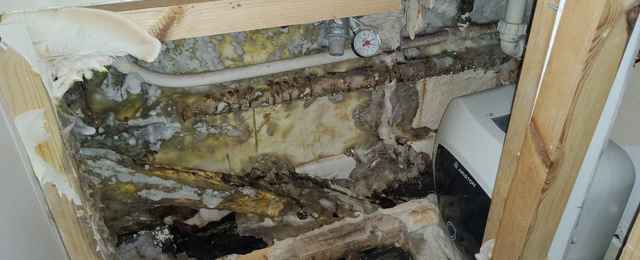
All timber that has lost structural integrity needs to be replaced while any fungal strands that remain must be removed
Conclusion: Act Before the Damage Spreads
Dry rot is a serious structural threat that should never be ignored or left to a temporary cosmetic fix. It can silently destroy the value, safety, and stability of your property from the inside out.
If you have discovered suspicious fluffy patches, deep cuboidal cracks, or a lingering musty smell in your property, taking immediate, professional action is the single most cost-effective decision you can make. Protect your property’s structural safety and integrity. Worried about dry rot in your property?
Book a professional survey with Peter Cox today to secure a permanent, guaranteed, and professional solution to timber decay.