
A Guide to Preventing Damp Problems
For many homeowners and property renovators, especially those managing older or heritage buildings, dampness is a persistent problem.
Whether you are dealing with water pooling against your foundations, porous masonry or dampness appearing at the base of external walls, finding a reliable fix is a top priority. One traditional solution often discussed is the French drain. But does a French drain actually stop damp, or is it merely a partial fix for a much larger structural issue?
What is a French Drain and How Does it Work?
A French drain is a traditional drainage solution designed to control moisture pooling around masonry properties and prevent potential damp problems.
Despite the name, its origin is more agricultural than international, popularised by the American Henry Flagg French in the mid-19th century to drain farmland.
The Structure of the Drain
The physical structure of a French drain is relatively straightforward:
- Trench around the property: A sloping channel is excavated along the perimeter of the property or in areas where water pools.
- Perforated Pipe: A pipe with small holes is laid at the bottom of the trench to collect water and direct it away from the property.
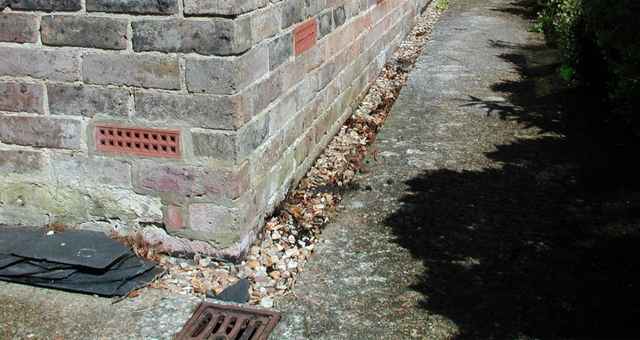
- Gravel Fill: The trench is filled with coarse gravel or stone, which allows water to easily seep down into the pipe while filtering out larger debris. The exposed gravel surface will collect run off from hard surfaces and prevent rainfall bouncing upwards above the damp proof course, causing damp.
The Physics of Water Redirection
The French drain operates on a simple principle of physics: water follows the path of least resistance.
By providing a gravel-filled channel, the pressure of groundwater is released and redirected into the perforated pipe. Likewise, surface runoff will run down into the gravel.
The pipe should be installed with a gradient to allow water to flow safely away from the foundation of the property and toward a suitable discharge point, such as a soakaway or storm drain. By keeping the ground immediately adjacent to the wall drier, a French drain can help prevent damp from occurring.
High ground levels and persistent pooling of moisture around the foot of a building are often the cause of internal damp problems. This is especially true if the exterior ground levels are higher than the internal walls.
Benefits of French Drains for Damp Control
While French drains will not solve all damp problems, especially if buildings are missing damp-proof courses, they will offer several significant benefits for exterior water management.
Managing Hydrostatic Pressure and Pooling
When heavy rain falls, water can pool against the foundation walls of a house. This creates hydrostatic pressure, literally the weight of the standing water pushing against your masonry. Over time, this pressure can force moisture through small cracks or porous bricks. A French drain relieves this pressure by providing an immediate pressure release and exit for the water.
Preventing Damp Proof Course (DPC) Bridging
In many properties, rising damp problems are caused by bridged damp proof courses. This happens when the external ground level (soil, flower beds, or new patios) is raised above the level of the DPC, allowing moisture to bypass the barrier and enter the wall. A French drain trench effectively lowers the “water line” next to the wall to a level below the existing DPC, helping to prevent moisture from bridging.
Protecting Below-Ground Spaces
For properties with below-ground basements or cellars, managing exterior groundwater is critical. A French drain acts as a first line of defence, reducing the volume of water that reaches the basement walls and decreasing the load on internal waterproofing systems.
Will a French Drain Stop Rising Damp?
A common question homeowners ask our surveyors is “Will a French drain stop rising damp?”
The reality is that while a French drain is an excellent tool for managing groundwater, it cannot replace a dedicated damp proof course (DPC). Rising damp is the result of capillary action, causing moisture to be pulled up through the microscopic pores of the masonry.
If the water table is high, or after periods of rain, the ground underneath your property will be saturated with moisture, which can then rise upwards by capillary action. This is why buildings for hundreds of years have been designed with a waterproof barrier to prevent this, in the form of a damp-proof course.
In areas with a high water table, your French drain may just become a water-filled gravel ditch at certain times of the year if it cannot be laid to waste without a pumped outlet.
If internal plasterwork is already contaminated with salts from the ground, this will also not be resolved by French drains. Internal damp patches caused by hygroscopic salts can come and go with the weather, even after a DPC is installed, if contaminated plaster has not been removed and replaced with a plaster containing a salt retardant additive.
French Drain Mistakes and Downsides
Despite their simplicity, French drains are often poorly engineered, leading to system failure or even increased damage to the property.
Poor Placement and Engineering
A common mistake is placing a French drain too close to the foundations without proper engineering. If a trench is dug too deep or too close to an old foundation, it can undermine the structural stability of the wall. For listed buildings, consent should always be sought as foundations may be shallow or non-existent, or the property may be supported by high groundwater levels. Additionally, if the drain is not correctly graded, it can actually act as a reservoir, holding water against the foundation rather than moving it away.
Maintenance and Maintenance Issues
French drains are not install-and-forget systems; they are prone to several downsides if regular maintenance is not carried out.
- Clogging: Over time, fine silt and soil particles can wash into the gravel and clog the perforated pipe.
- Silt Buildup: Without a geotextile fabric filter, the entire trench can eventually fill with mud, rendering the drain useless.
Root Ingress: Tree and shrub roots are naturally drawn to the water in the pipe and can quickly block the system.
Do You Need a French Drain Around Your House?
How do you know if a French drain is the right solution for your home? If your property is susceptible to these problems, you could benefit from French drains:
- Pooling Water: Standing water against your external walls after rain.
- Spongy Lawns: Lawns that stay saturated long after the rain has stopped.
- Base Dampness: Visible dampness at the very base of external walls.
- Porous Masonry Splashback: Walls suffering from penetrating damp caused by rain splashing off hard surfaces and soaking into porous bricks.
- Bridged DPC: Clear evidence that soil or paving is higher than your internal floor level and DPC.
Heightened ground levels around the base of the wall, or when gardens have been paved over.
Professional Drainage vs. DIY
While many homeowners consider a French drain a manageable DIY project, errors in depth, slope, or discharge can be costly. A professional installation ensures a well-engineered, compliant fix that considers the specific geology and architecture of your property.
DIY mistakes, such as discharging water into a neighbour’s property or an overloaded sewer, can also lead to legal complications. Professionals ensure the water is moved to a legitimate, high-capacity discharge point
Damp Surveys for Honest and Reliable Advice
A French drain is a powerful tool for exterior water management, but it must be part of a broader, comprehensive damp proofing strategy. It manages the symptoms of groundwater pooling, but it may not address the root cause of internal dampness.
If your property is suffering from damp problems and you are unsure of the best ways to prevent the problem, you may benefit from a damp and timber survey. A trained and qualified Peter Cox surveyor will determine if you actually need remedial damp proofing.
Don’t guess at the solution for your damp walls.Book a Professional Damp Survey with Peter Cox today to identify the true root cause of your damp problems.