
Discovering fluffy white crystallised deposits on your walls, noticing paint bubbling away from the plaster, or having dark patches come and go in a short period can be a major concern for homeowners. These symptoms are frequently caused by hygroscopic salts, often referred to as “salt damp”. Understanding the nature of salt damp and how it affects your home is the first step toward reclaiming your property from persistent moisture damage.
What are Hygroscopic Salts?
In technical terms, hygroscopic salts are minerals, most commonly nitrates and chlorides, that have the unique ability to attract and absorb moisture directly from the surrounding atmosphere.Groundwater beneath a property contains these dissolved salts. If no damp proof course (DPC) is present, moisture moves through porous materials like brick, mortar, and plaster, carrying these minerals with it. While the water eventually evaporates from the surface, the salts cannot; they are left behind, accumulating within the plasterwork and on the wall’s surface.
The Two Sides of Salt Damp
Identifying the root cause of salt contamination is critical, as it determines whether you are dealing with an ephemeral “now you see it, now you don’t” issue or a persistent structural problem.
1. Ephemeral Salt Damp: Damp Patches that “Come and Go.”
‘Real’ salt damp is characterised by damp patches that appear and disappear with the weather. This often occurs in properties where a new damp course has already been installed. Homeowners may fear the new DPC has failed, but the true cause is often contaminated plaster that was not removed or was replaced with an unsuitable plaster. Because the old salts remain in the wall fabric, they continue to pull moisture from the air whenever humidity levels rise, creating a recurring damp patch even without active rising damp. Because this ‘damp patch’ is not being fed by groundwater, very often there is little salt crystal formation on the surface.
2. Active Salt Banding: Persistent Rising Damp
If you have active rising damp, the symptoms are different. You will typically see salt bands on the wall that do not come and go because they are being constantly fed by moisture from below. This indicates a missing, deteriorated, or bridged damp proof course that is allowing groundwater to continuously migrate into the masonry, carrying salts with it.
What Causes Hygroscopic Salts in Walls?
Groundwater serves as the primary reason for salt migration into masonry. The scientific process follows four stages:
- Absorption: Moisture enters the base of the wall from the ground.
- Migration: Capillary action pulls salt-laden water upward through the bricks and mortar.
- Evaporation: Reaching the surface, the water evaporates into the room.
- Crystallisation: The dissolved salts stay behind, crystallising within the pores of the plaster and masonry, with some forming on the surface of the plaster. If nitrates and chlorides are present, these actively pull moisture out of the air and into the plaster and in so doing, make it damp.
How Does Salt Damage Walls?
Salt damp is incredibly destructive to internal finishes. Key indicators include:
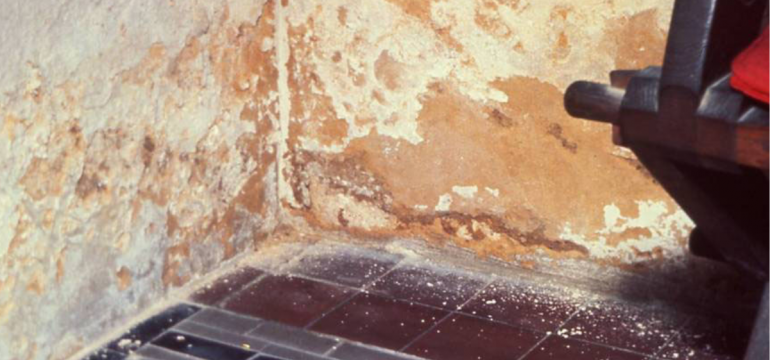
- Efflorescence: The appearance of white, powdery, or “fluffy” deposits on the surface. Multiple salts can be present, and in the case of the Weald of South East England, a lot of iron salts are present in the groundwater. This will lead to rusty brown salt bands being formed.
- Bubbling and Peeling: Expanding salt crystals push paint and wallpaper away from the wall.
- Crumbling Plaster: Pressure from crystallisation causes plaster to lose its bond and disintegrate.
- Persistent Damp Patches: Hygroscopic salts pull atmospheric moisture into the wall, causing damp spots regardless of rain.
The Professional Fix
A permanent solution requires a specialist approach that addresses both the moisture source and the contaminated fabric.
- Specialist Diagnosis: A professional surveyor identifies whether the issue is ephemeral salt damp from old contamination or active salt banding from a failed DPC.
- Plaster Removal: All salt-contaminated plaster must be physically removed to expose the masonry for treatment.
- DPC Remediation: If active rising damp is present, a new DPC is installed into a mortar joint at the correct height. If the existing DPC is simply bridged by debris, the bridge is cleared.
- Specialist Replastering: We use specialist plaster containing a salt-resistant additive. This prevents residual salts inside the masonry from migrating to the new surface, ensuring your decor remains intact.
Rising damp treatments carried out by Peter Cox are backed by a 20-year guarantee.
Conclusion
Salt damp is rarely a standalone issue; it is a symptom of how your home manages moisture. Whether your patches are “coming and going” or present as persistent bands, a professional survey is the only definitive way to find the root cause.Protect your home long-term. Book a Peter Cox Property Survey today to find a permanent, professional solution to salt damp.