Concerned about Damp? Book a Survey Today.
Book a survey online and save £25 off your survey fee

Call Today on 08082508820 * or Book a Survey Online
Dry rot (Serpula lacrymans) is a serious form of fungal decay that will not only cause damage to timber, but also spread throughout a property in search of new timber to attack.
Because of this, it's important to fully diagnose the extent of the problem, as it can often be found in hard to reach areas with a source of moisture.
Peter Cox are the market leaders in property preservation, and have been fixing dry rot outbreaks and the associated damp problems for decades, often backed by long term guarantees.
From domestic properties to commercial projects and heritage and listed buildings, we are here to provide you with long term solutions that protect your property from fungal decay.
With a network of local branches across the country, we will have qualified surveyors and experienced technicians near you.
Our surveyor will assess your property in order to determine the full extent of the dry rot outbreak, detail the source of moisture causing the problem and any other associated issues.
Our technicians will then be on hand to return your property to its former condition, removing fungal spores, replacing any damaged timber and carrying out replastering, meaning your property is protected long term.
We understand that having remedial work carried out in your property can be stressful, so from start to finish we will take steps to ensure work is carried out as smoothly as possible.
Peter Cox are a Which? Trusted Trader and are rated ‘Excellent’ on Trustpilot with over 2,500 independent customer reviews.
Dry rot is a very serious form of fungal decay, and if left untreated inside a home or property it can continue to spread, consuming both decorative and structural timber. The fungus responsible for dry rot removes the structural integrity of timber while also being able to spread through masonry and brickwork. This means It is capable of finding new timber throughout the property, unlike wet rot, which remains isolated at the source of moisture.
If left untreated, it can spread across full floors and up several stories. The infection is spread by spores that travel on air currents around the building and in voids. When these germinate on suitable damp timber, each spore can spread outwards around a metre a year. Though the growth rate is highly dependent on temperature and humidity.
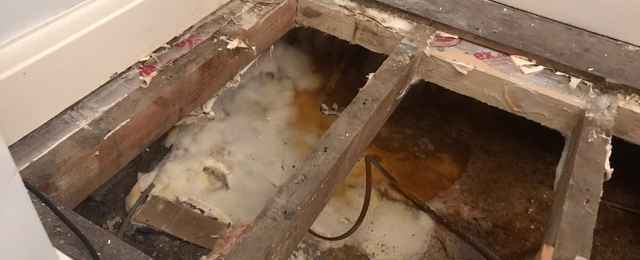
Conditions favourable to dry rot are often in hidden areas such as sub floor voids, and once the dry rot is found, often significant amounts of timber have been destroyed. It is not uncommon for whole floors to collapse due to damage. This will create safety hazards for the occupier if left untreated.
Dry rot can often remain hidden in sub floor voids until timber loses its structural integrity
Our timber treatments for dry rot are designed to deliver long-term protection. Peter Cox has decades of experience, with trained and experienced surveyors and technicians on hand to advise you.
Because dry rot can return if the full extent of the outbreak is not discovered, or if a moisture source is not addressed, it is essential when you have a dry rot problem that you seek professional advice from a CSTDB or CSRT qualified surveyor.
They will conduct a damp and timber survey which is used to identify fungal decay and the associated damp problems in buildings, with all findings provided to you in a survey report.
They will also check both the exterior and interior of the premises, to identify the source of damp causing the problem. This is often related to building defects, a lack of ventilation and in some cases, the requirement for damp proofing.
Internally a thorough inspection is required, as fungal decay can remain hidden under floorboards, behind panelling or in hidden and out of sight areas. If these areas are not thoroughly inspected, or a source of moisture is missed, the dry rot problem can return.
If you choose to go ahead with Peter Cox, a technician local to you will be on hand to carry out repairs. They will talk you through the process, and from start to finish will make sure to answer any questions.
Peter Cox have a number of local and experienced technicians who are experts in joinery, and can carry out dry rot repairs to the highest industry standards.
The first step in any dry rot treatment is to remove the source of moisture which was causing a heightened moisture content of the affected area.
Without identifying and remediating the source of moisture, the dry rot problem could reoccur. This is because dry rot spores and mycelium can lay dormant on surfaces and inside masonry, causing the problem to return if not addressed correctly.
Often dry rot is caused by moisture caused by a gentle plumbing leak, a lack of ventilation, condensation, rising damp, penetrating damp or because of external building defects.
Because dry rot often thrives in dark and damp conditions, improvements to ventilation may also be required in conjunction with other forms of damp proofing.
Airbricks can be used to help increase ventilation in sub floor voids, and in some cases PIV units or grilles may be required. Dry rot grows particularly well in poorly ventilated sub-floor spaces.
All decayed and severely damaged timber is then removed. While some timber may be retained, technicians will remove affected timber beyond the last visible signs of decay.
Surfaces may be wire brushed down to remove mycelium, and affected plasterwork may have to be removed.
Because of the nature of the spores, it is important to dispose of the wood and plasterwork safely to prevent any future spread. If the sub-floor void is congested with debris, this will be dug out to remove all food sources and to provide the correct depth for free airflow.
Our technicians will then apply the fungicide solution to the remaining wood to eliminate any further growth of remaining mycelium or spores.
If any masonry has been infected we will create a protective chemical barrier with the fungicide to further protect any timber in contact with the masonry. Masonry must be sterilised to prevent any existing fungal spores from germinating in the future.
Once our technicians are certain the dry rot has been treated, structural repairs may be needed if the timber has been compromised. The timber will be replaced as required.
In some cases, especially for heritage properties, where we do not want to replace the entire timber structure due to cost or historic value, we can carry out timber resin repairs.
Timber resin repairs can be used to bond a new section of timber to existing timber, creating a mechanical and seamless join. This is a useful option to prevent disruption to surrounding plasterwork while retaining as much original timber as possible.
Once the required timber has been replaced and any fungicidal treatments have taken place, our technicians can then relay new floorboards and replace skirting boards, if they have been significantly damaged by the dry rot outbreak.
The technician will carry out a final sign off and inform you on the next steps, drying out times and when the area is ready to be redecorated.
Peter Cox technicians are provided with tools and equipment to minimise dust and debris inside a property, meaning your home is left as tidy as possible. They will use floor coverings, dust sheets and are equipped with vacuums throughout the treatment process, and all Peter Cox technicians use Hilti dust extraction units which help remove airborne dust from the atmosphere while hacking off salt contaminated plaster, drilling or cutting timber.
Peter Cox are the leaders in property preservation, and have been supporting homeowners and commercial clients with work carried out to the highest standards, and backed by long term guarantees since 1951.
Our dry rot treatments are typically backed by a 20 year guarantee, giving you long term peace of mind the problem will not return. All details of our guarantee are provided in the survey report, and any guarantees applicable can be passed on to any future homeowners, should you wish to move house.
While it may be possible to deal with minor causes of dry rot if caught early enough, it is very easy to miss the extent of the infection, particularly if it has grown through masonry. You must be confident in joinery and the use of chemical treatments.
Where structural timber has been affected, or if the dry rot outbreak is severe, professional advice and assistance is strongly recommended. If you do not fully deal with the problem, dry rot strands can spread throughout your property, growing through masonry and behind plasterwork.
Ultimately this can lead to significant repair costs if not addressed properly. Using a company such as Peter Cox means that typical dry rot work is backed by a long term guarantee, giving you peace of mind the problem will not return.
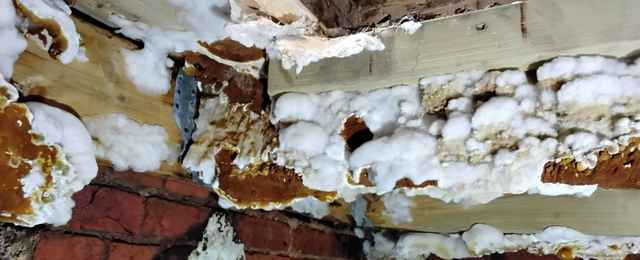
Dry rot repairs often fail as the full extent of the outbreak is not addressed, in this case Peter Cox were called out as a previous contractor did not eradicate the problem fully.
Living in a house affected by dry rot can be dangerous over time, primarily due to the risk of structural failure of timber leading to the collapse of floors or roofs.
Dry rot spores are not generally hazardous to humans, unless you have a specific allergy. If you notice signs of dry rot in your property it is highly recommended you seek professional assistance in order to prevent further damage to the structural integrity of your property.
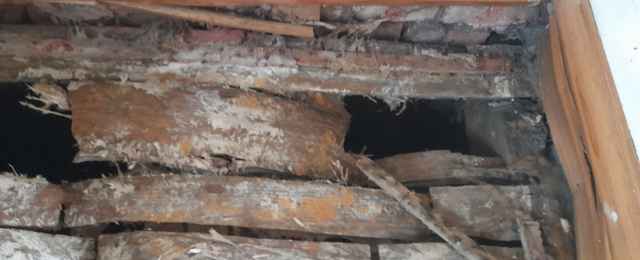
Dry rot can cause floorboards to lose structural integrity, and if left untreated, ultimately collapse
Dry rot treatment costs will vary depending on the extent of the damaged timber, whether or not plasterwork has been infected, and if damp proofing and ventilation improvements are needed to prevent the problem returning.
A professional damp and timber survey can provide answers on costs, after the surveyor has fully assessed the extent of the damage and investigated the source of moisture causing the dry rot outbreak.
From our network of local branches, we have full coverage across the whole of the United Kingdom, meaning experts close by to help you deal with your dry rot problem.
Find your local branch or get in touch with us today to book a damp and timber survey so we can help provide you with long term solutions.
When you choose Peter Cox for dry rot control, you are working with a company that has decades of property preservation expertise.
Every property is different, which means they each require personalised and professional advice and treatment plans in order to eradicate the dry rot problem.
Benefits of using Peter Cox for Dry Rot repairs include:
Our experienced surveyors will carry out a professional and thorough survey of your property, identifying the root cause of your problem. All their findings will be detailed in a survey report, backed with evidence to support their conclusions. If no work is required, we will make this clear in the report.
Peter Cox technicians will take precautions to look after your property from start to finish. They are provided with vacuums, floor coverings and sheeting to keep dust and debris to a minimum inside your property. We also provide our technicians with Hilti dust extraction units which help remove airborne dust whilst we work.
Our surveyors, technicians and office staff have years of experience and are extremely efficient, meaning we can complete the job in a timely manner, minimising disruption and preventing delays.
*Survey enquiries for your local branch will be directed to our dedicated central survey control teams across the UK. Calls to 0800 and 0808 numbers are free unless you are calling from a business phone, in which case the rate will be set by your provider.