
Call Today on 08082508820 * or Book a Survey Online
Replastering Damp Walls
Damp and mould growth are common problems that affect properties across the country and they can have a significant impact on the appearance and condition of plasterwork. Many people will see a damp problem affecting walls and assume damp treatments will require the walls to be replastered, but this is not always the case.
One of the most important steps is to understand what is causing your walls to be damp.
Condensation can cause the surface of cold walls to become damp as moisture laden air condenses, which in time can lead to mould growth. This may not require any replastering.
Penetrating damp is another way walls can become damp, as moisture from outside the property seeps its way through the masonry to the internal wall surfaces. The most common cause is driving rain soaking into porous masonry and mortar, but it can also be due to building defects like blocked gutters or defective roof coverings. If this is the case fixing the external source of moisture may stop the problem, without the need for replastering. If lateral penetrating damp caused by high ground levels is the source of moisture, replastering may be required.
If a penetrating damp problem is left over time, plasterwork can deteriorate to the point where it needs to be replaced, while penetrating damp can lead to other issues such as fungal decay, which may require plasterwork to be hacked off to allow for appropriate treatments.
Walls affected by rising damp will often need to be replastered due to hygroscopic salts (Nitrates and Chlorides) present in the ground water that rises up through masonry by capillary action. As the water evaporates from the plaster surface the salts are left behind and can form a salt band. Being hygroscopic, these salts grow as they pull water from the air back into the wall. This causes the plaster to deteriorate, flake and sometimes drop off. In some cases visible damp patches form, but come and go with the weather.
Because not all damp walls require replastering - it is important to accurately diagnose the type of damp. This is usually done through a damp survey carried out by a CSRT/CSTDB qualified surveyor - they will be able to tell you the type of damp causing the problem, and whether replastering is required.
Replastering in itself will not solve the root cause of the problem - this is why replastering must be carried out in partnership with damp proofing methods, specifically for the type of damp in question. Again, this is why accurate diagnosis is key, in order to provide a long term solution to the problem by treating it correctly.
Will Damp Plaster Dry Out?
If plaster has become damp over time, it will dry out if you remove the source of moisture that has caused the problem. Unless of course it contains hygroscopic salts, in which case the dampness will come and go with the weather (salt damp).
If there is a leak from a plumbing issue or faulty appliance, once this has been repaired the walls should dry out over time without the need for replastering. The time taken for walls to dry out will vary depending on the type of masonry, air temperature and the humidity inside the property. Typically solid walls will dry out at approximately 25mm (one inch) a month.
Increasing heating in the affected rooms, promoting airflow by opening windows or removing humidity in the air by using a dehumidifier, may also help the plaster to dry out quicker.
Even if damp walls dry out, the damage caused by issues such as rising damp will remain, and could even lead to further damp problems down the line through salts migrating from the brickwork through the plaster. This can cause what is known as salt damp and is why for cases of rising damp, plasterwork needs to be replaced.
Salt Efflorescence - What Causes Salt Damage?
Salt efflorescence is a white powdery substance that is most commonly noticed on exposed exterior walls. It occurs when moisture within the masonry causes dissolved salts within the masonry to migrate to the surface. These salts are in solution and become salt crystals when the water evaporates at the surface.
Masonry has tiny pores and through capillary action these pores draw up moisture from the ground, similar to drinking through a straw. This is why buildings are designed and built with a damp proof course (DPC), to create a physical barrier to prevent moisture rising upwards. When a DPC is not present, or if it has failed, moisture from the ground will rise up masonry, bringing hygroscopic salts which will then cause salt efflorescence on walls.
Salt efflorescence can also be caused by damp masonry from penetrating damp - this can be from building defects allowing moisture to penetrate into masonry, typically through cracks or missing mortar, or from backed up gutters running down brickwork. It can also be caused from lateral rain penetrating the masonry during periods of heavy rainfall, especially along the coast.
Regular maintenance and simple remedial repairs will prevent efflorescence caused by penetrating damp, and it will also prevent other issues such as wall tie failure and fungal decay.
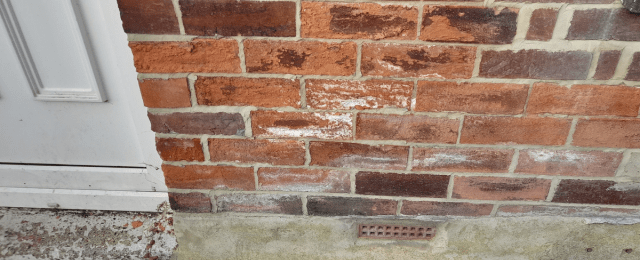
Salt efflorescence is often noticeable on exterior walls, especially when properties are affected by rising damp.
Salty marks are observable on the exterior of buildings which indicates a problem relating to damp masonry, but it doesn’t always mean the interior brickwork and plaster is affected, especially in cavity wall built properties. If you notice the same marks inside your property, this could indicate a rising damp problem, as salt laden moisture has risen upwards through the wall and evaporated inside the property, leaving behind salty residue on the plaster.
Rising damp can lead to unsightly damp patches, salty tide marks and can even lead to structural issues such as wet rot in joists and skirting boards. Once confirmed as rising damp by a trained and qualified professional, damp proofing will need to be carried out, and the affected plaster may need to be replaced.
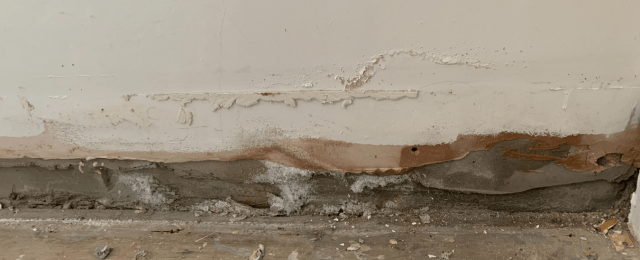
Hygroscopic salts can migrate through masonry causing damage to plasterwork and decorations.
Specialist Damp Proof Plaster
Peter Cox uses a specialist damp proofing plaster that contains a salt retardant additive to prevent salt migration. This makes it perfect for confirmed rising damp issues, and can be used in some situations for penetrating damp.
The plastering is normally a sand and cement render mix followed by a skim coat.
How to Replaster Damp Walls
The first step when carrying out treatments for damp walls is to have a damp survey to correctly diagnose the type of damp causing the issue, and the extent of the damage. Once a damp problem has been confirmed by a qualified surveyor, Peter Cox technicians will then carry out specialist treatments to protect your property.
A specially trained technician will then remove salt contaminated plaster from the wall affected by rising damp, as detailed in the surveyor report. This allows the injected damp proof course to be installed internally. Often the rising damp issue may only be just above the skirting board in your property, but it is important to remove the wall plaster high enough to ensure we get rid of all the salt affected plaster. The salts may be in the wall and not visible currently, but over time these salts can migrate to the surface, giving the illusion of a new rising damp problem.
Peter Cox will carry out replastering 300mm higher than the highest salt stains and to a minimum height of one metre. Once the plaster has been removed the technician will drill holes horizontally around 120mm apart into the wall mortar joint approximately 150mm above the external ground level. Depending on wall construction the damp course may be installed from the inside, outside or both.
Although the wall has a new damp proof course, the masonry will still be wet and may contain hygroscopic salts. Therefore replastering materials need to create a barrier preventing salts from affecting the new plasterwork. This is when the salt retardant plaster is applied, preventing salts from migrating through the new plasterwork. It’s important the plasterwork finishes just above the installed damp proof course, to prevent a ‘bridge’ for the moisture to bypass the damp proof course. The slight gap will be covered by the skirting board.
Is Damp Proofing and Replastering messy?
As treatments for rising damp and replastering involve the removal of plaster, and drilling into brickwork it is unavoidable there will be some dust and mess. That said, Peter Cox takes precautions to protect your property, and leave it as tidy as possible once we have carried out our treatments.
Peter Cox technicians are provided with vacuums, floor coverings and sheeting to keep dust and debris to a minimum inside your property. We also provide our technicians with Hilti dust extraction units which help remove airborne dust from the atmosphere while hacking off salt contaminated plaster, drilling or cutting timber. Using dust extraction units means that it’s not only safer for technicians working in your property, but it also reduces the amount of dust settling, while reducing the dust particles moving throughout your home.
Damp Walls caused by Condensation
Condensation is the most common type of damp, and it affects as many as one in five properties every year, especially in winter. Warm moist air will condense on cool surfaces, and this is a common problem on cold solid external walls, especially those that face North and therefore do not receive as much direct sunlight. Condensation will form on walls if they are not well insulated, as a cold bridge forms between the outside of your home and the inside.
Because the source of moisture is from the air inside the property, the surface of the wall may be wet but the masonry that makes up the wall will be dry. Over time, damp walls can cause wallpaper to peel, and paint and plaster to degrade, and can even cause musty smells and mould growth. This does not mean that the existing walls need to be damp proofed, but the cold surfaces must be addressed to prevent condensation and mould growth forming. This can be done by improving ventilation to remove excess moisture in the air, or by increasing the thermal values of the cold walls.
Thermal plastering systems can be used to create a thermal barrier that stops cold spots on walls, and can help reduce energy bills. Due to the thin insulating tile design, your walls can be insulated without costly alterations to skirting boards, windows, covings and radiators.
Why Choose Peter Cox
If you are unsure about whether or not you require replastering because of a damp issue, a trained Peter Cox surveyor will be able to accurately diagnose the type of damp, and provide you with advice and options for treatment.
- We have CSRT and CSTDB qualified surveyors located across the country, working from our network of local branches. Their survey report will detail any issues found and recommendations for further treatments, but only when required.
- Our trained technicians will then carry out specialist repairs to stop the root cause of the damp problem, while taking care of your property from start to finish.
- Typically our damp proofing treatments for rising damp come with a long term guarantee, giving you peace of mind the problem is solved, and you won’t have any further issues with the newly plastered walls.
- We are a Which? Trusted Trader and we’re rated ‘Excellent’ on Trustpilot with over 2,500 independent customer reviews.
Replastering Damp Walls FAQs
-
Do damp walls need replastering?
This depends on the type of damp affecting the walls, and whether the plaster has become contaminated with hygroscopic salts. If salts are confirmed it is essential that the wall is replastered with a salt retardant render to prevent the salts migrating back through the plaster. A damp proof course must be installed to prevent further salt migration upwards through the wall by capillary action. A damp and timber survey should always be carried out to fully understand the type of damp affecting the property, if timbers have been affected, and to confirm whether or not the plaster needs to be replaced.
-
What happens if you plaster over a damp wall?
Plastering over a damp wall without carrying out damp proofing will not solve the root cause of the problem, and could lead to damp patches reappearing. Moisture can become trapped within the masonry, leading to issues such as cracking, blistering and salt contamination.
-
How much does it cost to fix damp walls in the UK?
The cost of treating damp walls will depend on the size of the affected area, and whether or not a new remedial damp proof course is required. A damp and timber survey will provide you with answers on the root cause of the damp problem, and a quotation for work to be carried out.
-
Do plasterers do damp proofing?
No, plasterers typically will not carry out damp proofing work, because it is a specialised process that requires a detailed survey to fully understand the source of the damp. Specialised property preservation companies will have qualified surveyors who will carry out a damp and timber surveys, confirm the type of damp causing the problem, and whether replastering is required. Work carried out by a specialist company will often come with a long term guarantee, something plasterers may not be able to offer.
Next Steps
*Survey enquiries for your local branch will be directed to our dedicated central survey control teams across the UK. Calls to 0800 and 0808 numbers are free unless you are calling from a business phone, in which case the rate will be set by your provider.